

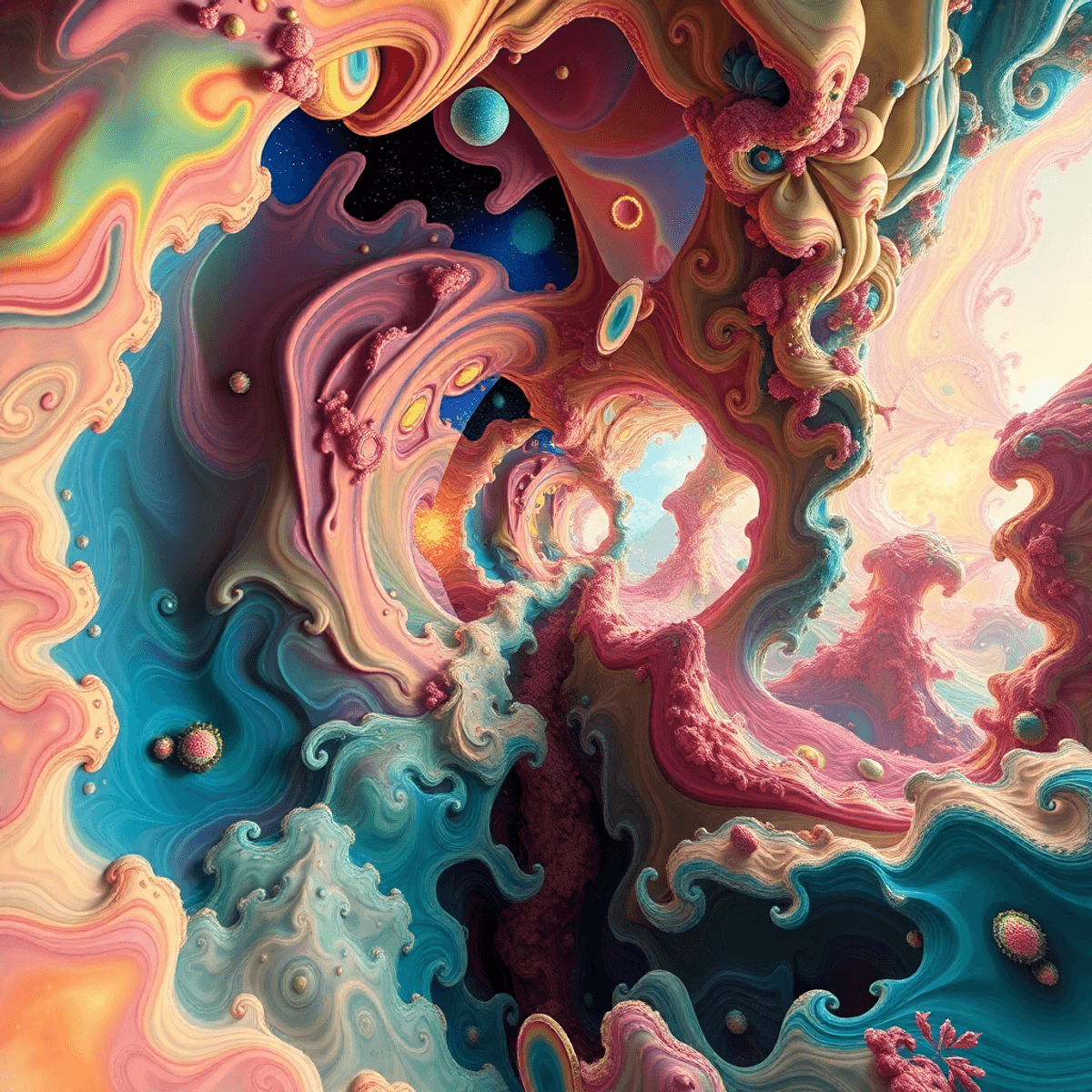
Zoomquilt is an innovative web project that captured the internet’s imagination in 2004 and sparked a new genre of digital art.
Unlike traditional artwork confined by physical boundaries, Zoomquilt creates an infinite zoom visual experience through seamless transitions between fantastical scenes. The project changed how we think about digital art by combining:
- Animation techniques that loop back on themselves
- Principles of fractals, where shapes repeat at different scales
- Web design that immerses users in the experience
- Collaboration among multiple artists
The result? A mesmerizing digital experience that pulls viewers into an endless visual story. Each frame smoothly transforms into the next, creating a continuous flow that challenges our perception of space and boundaries.
This groundbreaking project didn’t just go viral – it opened up new possibilities for artistic expression in the digital age. By merging technical innovation with creative vision, Zoomquilt showed how web browsers could become gateways for immersive art experiences.
What makes these infinite zoom websites so captivating? How do they work? Let’s explore the fascinating world of endless zoom animations and delve into the intersection of art, technology, and human perception.
The Origins of the Infinite Zoom Website Phenomenon
In October 2004, a digital art experiment emerged that would reshape how we experience web-based creativity. Zoomquilt burst onto the scene during the early days of Flash animation, marking a pivotal moment in interactive digital art history.
The Vision Behind Zoomquilt
The project began as a collaborative effort between digital artists who shared a vision: creating an endless journey through seamlessly connected illustrations. Each artist contributed unique segments that flowed into one another, crafting surreal landscapes and dreamlike transitions that defied traditional artistic boundaries.
How Zoomquilt Was Built
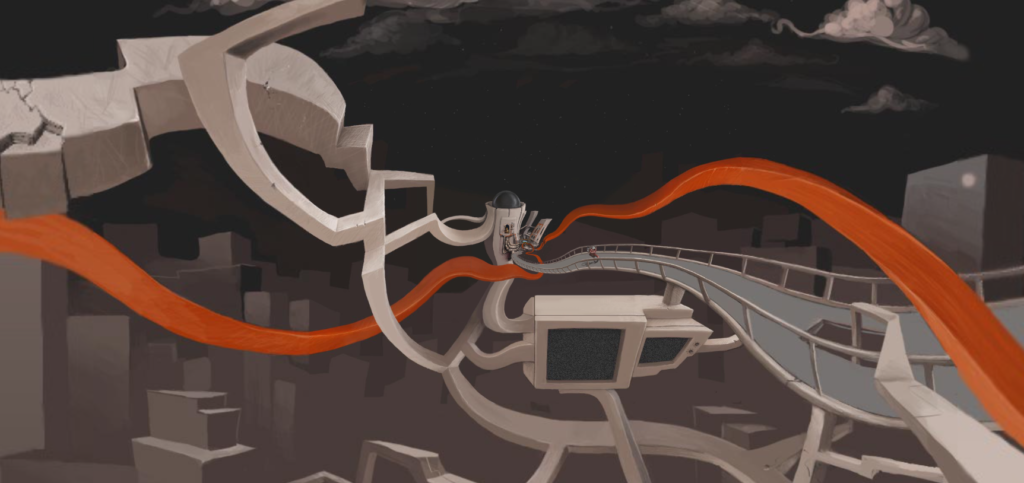
The technical architecture behind Zoomquilt relied on Flash technology – the dominant platform for web animations in 2004. Internet Archive snapshots reveal the original site’s structure: a simple interface with a hypnotic central animation that drew visitors into its depths.
How Zoomquilt Spread
The site’s viral spread happened organically through:
- Art forums like DeviantArt and CGSociety
- Early social bookmarking sites including Digg and StumbleUpon
- Flash animation communities
- Personal blogs and web directories
The Impact of Zoomquilt on Digital Art Communities
Digital art communities embraced Zoomquilt as a groundbreaking example of collaborative web art. The project demonstrated how multiple artists could work together to create something greater than the sum of its parts. Each contributor’s distinct style merged into a cohesive visual narrative that felt both alien and familiar.
The Timing of Zoomquilt’s Release
The timing of Zoomquilt’s release coincided with growing interest in interactive web experiences. As documented by various tech blogs from 2004-2005, the site represented a new form of digital expression – one that combined traditional illustration with the unique possibilities of web technology.
Early Reactions to Zoomquilt
Early forum discussions and blog posts captured the initial reactions:
“It’s like falling through an infinite painting” – CGSociety user, 2004 “This changes how we think about web art” – Digital Arts Magazine
The Influence of Zoomquilt on Other Artists
The project’s success inspired numerous similar experiments in recursive animation and collaborative digital art. Artists began exploring new ways to create seamless, infinite experiences that pushed the boundaries of web technology and visual storytelling.
Understanding the Technology Behind Endless Zoom Animation
The magic of endless zoom animations lies in a combination of precise mathematics and creative artistry. At its core, these mesmerizing experiences rely on recursive layering – a technique where each image contains elements that seamlessly transition into the next scene through careful positioning and scaling.
The Technical Architecture
The technical architecture involves:
- Vector-based scaling that maintains image quality during continuous zoom
- Preloaded asset management to ensure smooth transitions between scenes
- Dynamic viewport calculations adjusting to user interaction speeds
- Memory optimization techniques preventing performance degradation
Managing Visual Continuity Challenges
Creating smooth visual continuity presents unique challenges. Developers must carefully manage the parallax effect – the apparent displacement of objects when viewed from different positions. This requires precise mathematical calculations to maintain consistent zoom speeds and prevent visual artifacts or “jumps” between scenes.
javascript // Example of basic zoom calculation const zoomFactor = 1.01; const scaleValue = Math.pow(zoomFactor, deltaTime);
Powering Animations with Modern Web Technologies
Modern web technologies power these infinite journeys. WebGL handles the heavy lifting of real-time graphics rendering, while JavaScript orchestrates the complex choreography of image transitions. The implementation typically includes:
- Texture mapping for seamless image blending
- Frame buffering to prevent visual tearing
- Dynamic asset loading based on zoom depth
- Interpolation algorithms for smooth transitions
According to MDN Web Docs, efficient handling of these elements requires careful consideration of browser capabilities and memory management. Research published in the Journal of Computer Graphics Techniques suggests that optimal performance comes from maintaining a balance between image quality and computational load.
Creating Depth with Fractal Principles
The technical architecture employs fractal principles – patterns that repeat at different scales. This mathematical foundation enables the creation of seemingly infinite depth while using finite resources. Each layer connects through carefully crafted transition points, creating an illusion of endless descent or ascent through digital space.
Advancements in Animation Capabilities
Recent developments in GPU acceleration and browser rendering capabilities have pushed the boundaries of what’s possible with endless zoom animations. These advancements allow for higher resolution assets, more complex transitions, and smoother performance across different devices and platforms.
The Quirky Side of Endless Zoom Animations
Interestingly, this concept isn’t limited to serious applications or artistic endeavors. It also finds its place in some weird websites that defy conventional expectations. Some users even explore the useless web, a realm filled with bizarre but fascinating sites that serve no real purpose other than entertainment or curiosity.
Artistic Elements in Zooming Artwork: Blending Creativity with Code
The surreal landscapes of Zoomquilt showcase a mesmerizing dance between artistic vision and technical execution. Artists craft intricate scenes that dissolve and transform into each other, creating a dreamlike narrative that defies traditional artistic boundaries. Each frame serves as both a destination and a gateway, demanding meticulous attention to detail and seamless visual flow.
The collaborative nature of Zoomquilt 2 brings together 31 distinct artistic voices, each contributing their unique style while maintaining visual coherence. This artistic diversity manifests in:
- Varied color palettes that shift subtly between scenes
- Distinct artistic techniques ranging from photorealistic to abstract
- Thematic elements that weave throughout the journey
- Architectural impossibilities that bend reality
Digital tools enable artists to push beyond the limitations of traditional media. Software like Adobe Creative Suite and specialized digital painting programs allow for:
- Precise control over transition points between scenes
- Complex layering effects that enhance depth perception
- Real-time collaboration and iteration between artists
- Pixel-perfect alignment of connecting elements
The artistic process behind zooming artwork demands a unique approach to composition. Artists must consider both the micro and macro aspects of their work:
“Creating for infinite zoom requires thinking in layers of reality. Each scene must work independently while flowing naturally into the next, like a visual Russian doll.” – Digital Artist Magazine
The rise of digital art platforms has transformed collaborative possibilities. Artists can now:
- Share work-in-progress remotely
- Receive instant feedback from collaborators
- Maintain version control across multiple iterations
- Blend different artistic styles seamlessly
This fusion of individual creativity and collective vision produces a rich tapestry of visual storytelling. Each zoom reveals new details, hidden meanings, and artistic flourishes that reward repeated viewing and exploration.
Zoomquilt 2: Evolution and Enhanced Visual Immersion
Nikolaus Baumgarten’s 2007 release of Zoomquilt 2 marked a significant improvement in the infinite zoom experience. This ambitious sequel pushed creative boundaries by incorporating a larger team of artists and implementing advanced web technologies to deliver more immersive visual storytelling.
Stunning 4K Resolution Capability
The most impressive advancement in Zoomquilt 2 is its ability to support stunning 4K resolution. This means that each frame of the artwork can display incredibly fine details that were previously impossible to capture:
- Microscopic textures within surreal landscapes
- Subtle color gradients between scene transitions
- Crystal-clear definition in both light and shadow elements
- Seamless blending between artistic styles
Active Exploration through Enhanced Resolution
The improved resolution transforms passive viewing into an active exploration. Users can now discover hidden elements and artistic nuances with each zoom iteration, creating unique journeys through the infinite canvas.
Technical Improvements for Smoother Experience
Zoomquilt 2’s technical improvements go beyond just increasing the number of pixels. The project also implements:
- Advanced frame interpolation for smoother transitions between frames
- Dynamic loading systems to efficiently handle high-resolution assets
- Optimized rendering techniques, such as those discussed in this resource on optimizing rendering of particle systems, to ensure consistent performance across different devices
These technical refinements serve the artistic vision by maintaining the hypnotic flow that makes infinite zoom experiences so captivating. The higher fidelity allows viewers to fully immerse themselves in the details without any technical distractions breaking their experience.
Diverse Visual Elements and Narrative Threads
The project’s expanded artistic scope is evident in its wide range of visual elements. Each scene flows seamlessly into the next with careful precision, creating narrative threads through abstract spaces. The enhanced resolution brings out subtle artistic signatures within each segment while still preserving the cohesive dreamlike quality that defines the Zoomquilt experience.
Setting New Standards for Web-Based Interactive Art
The combination of technical excellence and artistic vision in Zoomquilt 2 has set new standards for web-based interactive art. Its influence continues to inspire digital artists and developers who are pushing the boundaries of browser-based animation.
The Psychological Impact and Appeal of Trippy Zoom Websites
The mesmerizing nature of endless zoom websites taps into fundamental aspects of human psychology and perception. Research published in Neuroscience Letters suggests that recursive visual patterns can trigger alpha wave activity in the brain, associated with meditative states and increased focus.
These digital experiences create what psychologists call a “flow state” – a mental condition where viewers become deeply absorbed in the continuous visual journey. The seamless transitions between surreal scenes activate the brain’s pattern recognition systems while simultaneously defying expected spatial relationships.
Why Are Trippy Zoom Websites So Appealing?
The psychological appeal of trippy zoom websites connects to three key factors:
- Pattern Recognition Disruption: The brain constantly seeks to establish order in visual information. Infinite zoom challenges this process by presenting ever-changing patterns that never resolve, creating a captivating cognitive tension
- Time Perception Alteration: Studies from the Journal of Consciousness Studies indicate that exposure to fractal-like animations can distort subjective time perception, making minutes feel like moments
- Meditative Engagement: The predictable yet ever-changing nature of zoom animations mirrors traditional meditation aids like mandalas, promoting a state of focused awareness
How Do Trippy Zoom Websites Affect Our Brain?
The relationship between digital art and altered states of consciousness extends beyond simple entertainment. Neuroscience research shows that viewing recursive animations activates similar neural pathways as traditional psychedelic experiences, though in a much milder form. This connection explains why many users report losing track of time while exploring these digital landscapes.
Recent studies in visual neuroscience reveal that the human brain processes continuous zoom motion differently from other types of movement. The constant forward progression triggers what researchers call “vection” – an illusion of self-motion that can induce mild dissociative states and enhance immersion in the digital experience.
Creating Engaging Digital Journeys
Artists and developers harness these psychological principles to create increasingly sophisticated zoom experiences. By understanding how the brain processes continuous motion and pattern recognition, creators can design more engaging and immersive digital journeys that blur the line between art and altered consciousness.
Beyond Browsers: Infinite Zoom Art as Mobile Live Wallpapers and More
The mesmerizing appeal of infinite zoom art has broken free from browser windows to transform our everyday mobile experiences. Creative developers have adapted Zoomquilt’s hypnotic concept into dynamic live wallpapers, bringing endless visual journeys right to our smartphone home screens.
These mobile adaptations present unique technical hurdles:
- Resource Management: Mobile devices require optimized image compression and efficient memory usage to maintain smooth animations
- Battery Conservation: Developers implement smart throttling mechanisms to balance visual quality with power consumption
- Touch Integration: Mobile versions incorporate gesture controls, allowing users to manipulate zoom speed and direction with intuitive swipes
Popular platforms like Android’s Live Wallpaper API have sparked a wave of infinite zoom implementations. Apps such as “Infinite Zoomer” and “Deep Space Journey” demonstrate how these mesmerizing backgrounds can enhance mobile user experiences without compromising device performance.
The technical architecture behind mobile infinite zoom typically includes:
- Layered sprite systems for seamless image transitions
- Dynamic texture loading to manage memory constraints
- Frame interpolation for smooth animation at lower processing costs
- Adaptive resolution scaling based on device capabilities
Beyond live wallpapers, infinite zoom art has inspired interactive screensavers, digital art installations, and even meditation apps. Museums and galleries have incorporated large-scale versions into immersive exhibits, while digital artists experiment with AR implementations that blend real-world spaces with endless zoom effects.
Game developers have also embraced the concept, creating titles where infinite zoom mechanics drive core gameplay. These adaptations prove how versatile and engaging recursive animation can be across different digital platforms and contexts.
The Legacy and Future Potential of Endless Zoom Animations on the Web
Zoomquilt’s influence ripples through contemporary digital art, sparking a renaissance in web-based creative expression. Modern artists and developers draw inspiration from its pioneering approach, crafting installations that push the boundaries of interactive storytelling. Projects like Deep Sea and Cosmic Journey combine endless zoom mechanics with responsive sound design and user-triggered events, creating multi-sensory digital experiences.
The Role of Artificial Intelligence
The integration of artificial intelligence opens new frontiers for infinite zoom art. AI algorithms can now generate seamless transitions between scenes, enabling dynamic, ever-evolving landscapes that adapt to user interactions. Platforms like RunwayML and Artbreeder demonstrate the potential for AI to create infinite variations of interconnected imagery, expanding the possibilities for endless zoom experiences.
The Impact of Virtual Reality
Virtual reality technology amplifies the immersive nature of infinite zoom art. Projects in development include:
- VR Zoom Galleries: Virtual spaces where users physically move through endless zoom installations
- Interactive Story Worlds: Narrative experiences where zooming reveals plot elements and character details
- Collaborative VR Canvases: Shared spaces where multiple artists contribute to evolving zoom landscapes in real-time
The Contribution of the Open-Source Community
The open-source community actively builds upon Zoomquilt’s legacy. GitHub repositories showcase experimental frameworks for creating smooth zoom animations, while CodePen artists share innovative techniques for achieving seamless transitions. Notable projects include:
- ZoomJS: A lightweight library for implementing infinite zoom effects
- FractalFlow: An open-source tool for generating procedural zoom animations
- InfiniteCanvas: A community-driven platform for collaborative zoom art creation
The Potential of Web3 Technologies
Web3 technologies introduce possibilities for decentralized zoom art experiences. Artists experiment with blockchain-based platforms to create interactive NFT collections that incorporate endless zoom mechanics, allowing collectors to explore infinitely detailed digital assets.
Future Prospects with Quantum Computing
Research in quantum computing suggests future applications for generating complex fractal animations at unprecedented scales. Scientists explore algorithms that could render infinite detail in real-time, creating zoom experiences that mirror the mathematical complexity of natural systems.
Conclusion
The infinite zoom website phenomenon shows the endless possibilities when art and technology come together. From the early days of Zoomquilt to the advanced digital experiences we have today, these captivating creations push the limits of web-based storytelling.
The combination of endless zoom animations with new technologies opens up new opportunities for artistic expression. As AI-generated content, virtual reality, and advanced web technologies continue to develop, we can expect to see even more immersive and mind-bending digital journeys.
These mesmerizing digital spaces do more than just entertain—they challenge how we perceive space, time, and narrative structure. The success of projects like Zoomquilt shows our deep human connection to infinite patterns and continuous motion, while also hinting at a future where digital art goes beyond traditional boundaries.
The next chapter in this evolving story may redefine how we experience art in the digital age, turning browsers into gateways to limitless realms of imagination.